Chatwood Labs Releases BOUT++ Grid Diagnostics and Validation Utility
Second public tooling release from the Chatwood Labs simulation stack adds automated grid validation, diagnostics, and visual reporting for BOUT++ workflows.
Chatwood Labs has released an open-source grid diagnostics and validation utility for BOUT++ 4.x and 5.x environments, marking the second public release from the company’s internal simulation toolchain.
The utility was developed as a direct companion to the tokamak grid generator released in December 2025. As the simulation programme moved into higher-dimensional MHD modelling, the need for rigorous pre-run validation of grid geometry became increasingly important. A grid that appears correct can still produce solver instability, numerical failure, or physically misleading results if metric tensors, Jacobian conventions, or magnetic field structure contain subtle errors. This tool was built to catch those failure modes before they reach the solver.
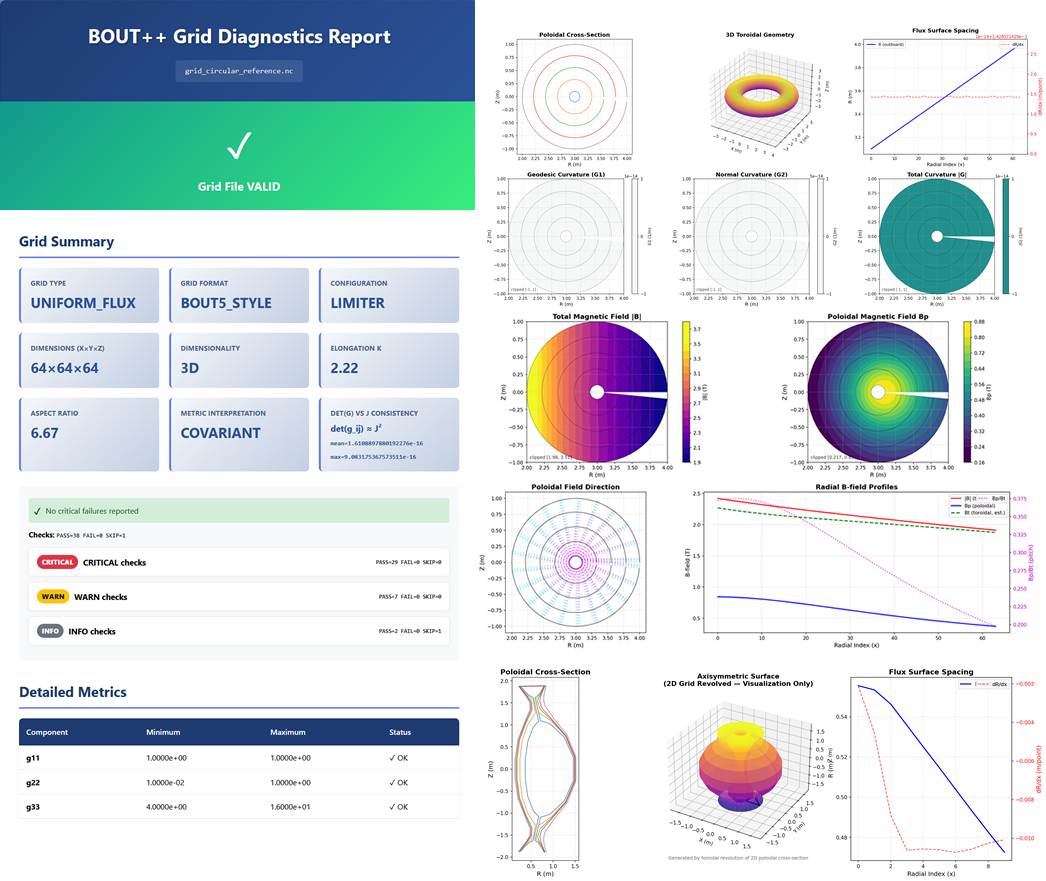
The software performs a broad set of automated checks against BOUT++ grid files, including validation of metric tensor structure, Jacobian sign consistency, determinant-to-Jacobian agreement, surface volume integrity, NaN and Inf scanning, and shift-angle monotonicity. Together, these checks are designed to catch both numerical and convention-level issues that can otherwise remain hidden until runtime.
Alongside the automated checks, the utility generates visual diagnostic reports covering flux surface geometry, grid spacing behaviour, curvature structure, magnetic field magnitude, poloidal field behaviour, and radial field profiles. Reports are produced in both human-readable HTML and machine-readable JSON formats, making the release suitable for both manual inspection and automated workflow integration.
An explicit exit-code contract is included to support reproducible simulation environments and CI-based validation pipelines. The utility has been tested against grids from the Hypnotoad integrated test suite, Hermes, and the Chatwood Labs grid generator, including circular reference, ITER-inspired, and extreme-shaping configurations.
Version 1.0.0-Public is available under the MIT Licence through the Chatwood Labs GitHub repository. The release extends the company’s growing open technical tooling stack as its simulation programme moves deeper into multi-dimensional analysis.
Based in Greater Manchester, Chatwood Labs is developing its research programme around simulation, control architecture, and staged technical validation, with open technical tooling forming part of that effort.