Chatwood Labs Observes Provisional Phase-Dependent Response in 3D Reduced-MHD Simulation
Early BOUT++ simulation work suggests phase-dependent fuelling behaviour persists in a higher-dimensional reduced-MHD setting, supporting continued investigation of timing as a control variable.
Chatwood Labs has observed an encouraging provisional result from recent BOUT++ simulation work, extending the control hypothesis explored in its pre-print, Phase-Aligned Fuel Injection in a Reduced Burn Propagation Model.
The earlier study examined whether fuelling response depends on injection phase relative to a travelling burn crest in a reduced one-dimensional toroidal model. In that model, poorly phased injection behaved similarly to the no-injection baseline, while wake-aligned injection extended crest persistence.
Chatwood Labs has now begun testing the same control hypothesis in a higher-dimensional setting using a 3D reduced-MHD simulation framework.
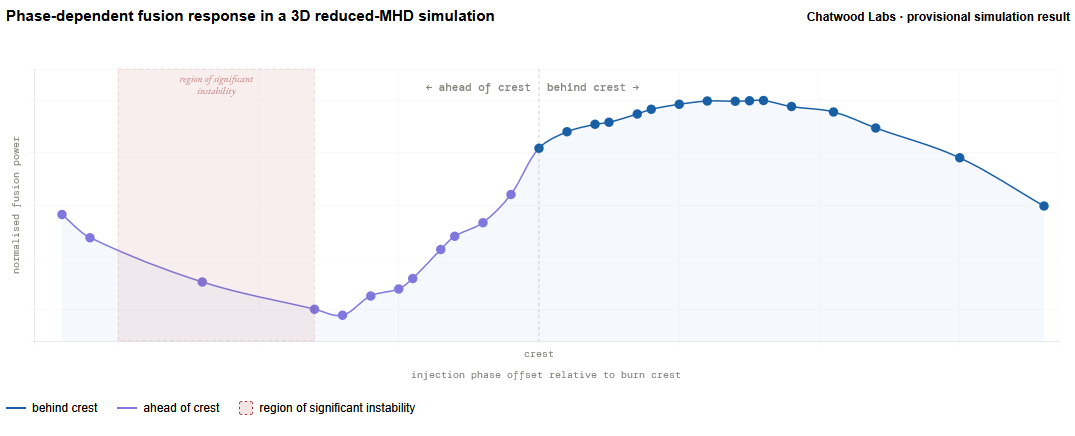
The early result suggests that the fusion response remains phase dependent. Injection ahead of the travelling crest enters a region of significant instability, while injection behind the crest produces a stronger sustained response. This behaviour is consistent with the core idea behind Wake-Aligned Fuel Injection: that timing relative to evolving plasma structure can materially affect system behaviour.
This is not a validation claim. It is a provisional simulation result, with a long way still to go through sensitivity testing, diagnostics and higher-fidelity work.
However, the result represents an important next step. The key question following the earlier reduced-order work was whether the phase-alignment signal would disappear when moved into a higher-dimensional plasma model. In this initial BOUT++ result, it did not.
The observed response is also not simply a smooth rise and fall. It appears more consistent with a nonlinear phase-response landscape, where different injection phases can produce sustained response, degradation or instability. This supports Chatwood Labs’ view that fuelling should be treated as part of the control architecture, rather than only as a fuel delivery parameter.
Further work will focus on characterising the sensitivity of the result, expanding diagnostic coverage, testing robustness across simulation settings, and advancing toward higher-fidelity modelling.
This work forms part of the wider Chatwood Labs simulation programme, focused on reduced-order modelling, higher-dimensional testing, live diagnostics, and the staged development of control-oriented fusion concepts.