Modelling & Simulation
Multi-dimensional physics models for burn-wave formation, stability, and failure
Overview
Our modelling work centres on understanding how fusion burn waves form, propagate, and fail. Rather than assuming equilibrium, we build time-dependent simulations that capture the dynamic behaviour of plasma as it evolves through different regimes.
This approach allows us to test control strategies in silicon before committing to hardware, identify failure modes early, and develop diagnostics that track the plasma state in real time.
BOUT++ MHD Simulations
We run 3D magnetohydrodynamic simulations using BOUT++, a framework developed by the fusion community for studying plasma turbulence and transport. Our custom physics modules include:
- Phase-synchronized fuelling operators - injection coupled to estimated burn-front phase.
- Propagation & stability study - transport, curvature effects, and nonlinear feedback.
- Energy deposition / heating model - configurable source terms for wave evolution.
- Thermal management concepts - cooling and controllable loss channels (modelled).
- Real-time telemetry & control diagnostics pipeline - streamed, in-run inspection of plasma state, burn-front evolution, and control response at fixed cadence to accelerate iteration and reduce I/O overhead.
Current development runs operate at ~68×128×128 resolution (radial × poloidal × toroidal), evolving fully three-dimensional fields to resolve wave propagation and control-relevant dynamics while maintaining rapid iteration speed.
Grid Generation & Validation Infrastructure
Our simulation infrastructure includes custom tokamak grid generators and diagnostic tooling designed to support controlled geometry variation, robust verification, and physically consistent coordinate systems. These tools are developed to ensure simulations do not silently violate geometric or magnetic constraints as models move away from near-equilibrium assumptions.
Most standard grid pipelines assume axisymmetric, near-equilibrium conditions and provide limited feedback when those assumptions are strained. Our approach prioritizes explicit geometry control and automated validation so that modelling errors are detected early rather than absorbed into downstream results.
Core capabilities include:
- Analytic tokamak geometries with adjustable aspect ratio, elongation, and triangularity
- Flux-aligned coordinate systems that preserve magnetic field-line structure
- Metric tensor and Jacobian computation with automated consistency checks
- Geometry and metric validation pipelines to catch setup and discretization errors before runtime
Public versions of these tools are released on GitHub to support reproducibility and external validation, while remaining actively integrated into our internal modelling and validation pipeline.
Open-source tools available:
- Axisymmetric tokamak grid generator - BOUT++ 5.x compatible, supporting elongation (κ), triangularity (δ), and configurable safety-factor profiles
- Grid diagnostics utility - Automated validation of metric tensors, magnetic field consistency, Jacobian correctness, and geometric self-consistency
- Validation against experimental geometries - Tested on DIII-D reconstructions and Hypnotoad/Hermes reference grids
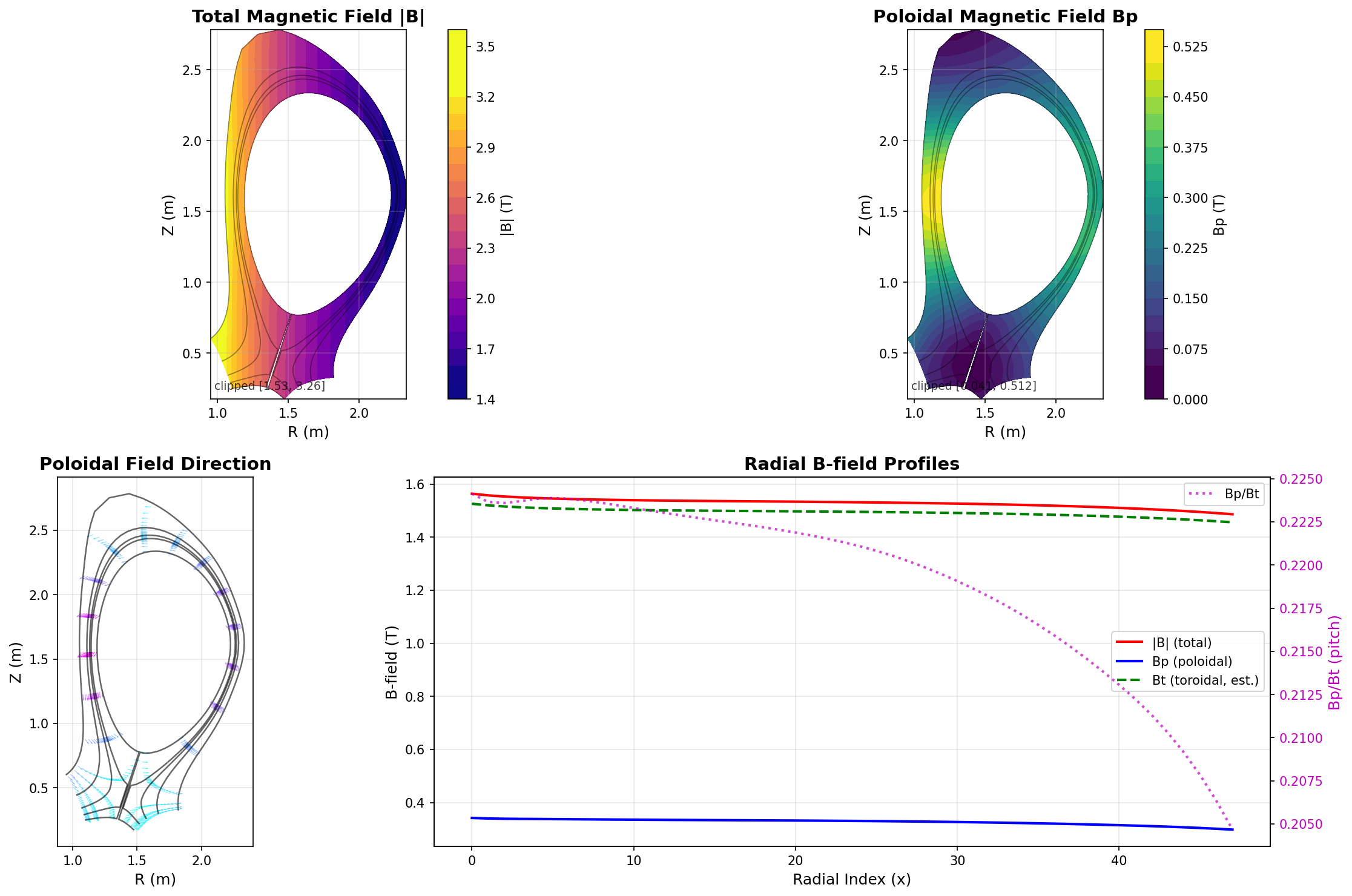
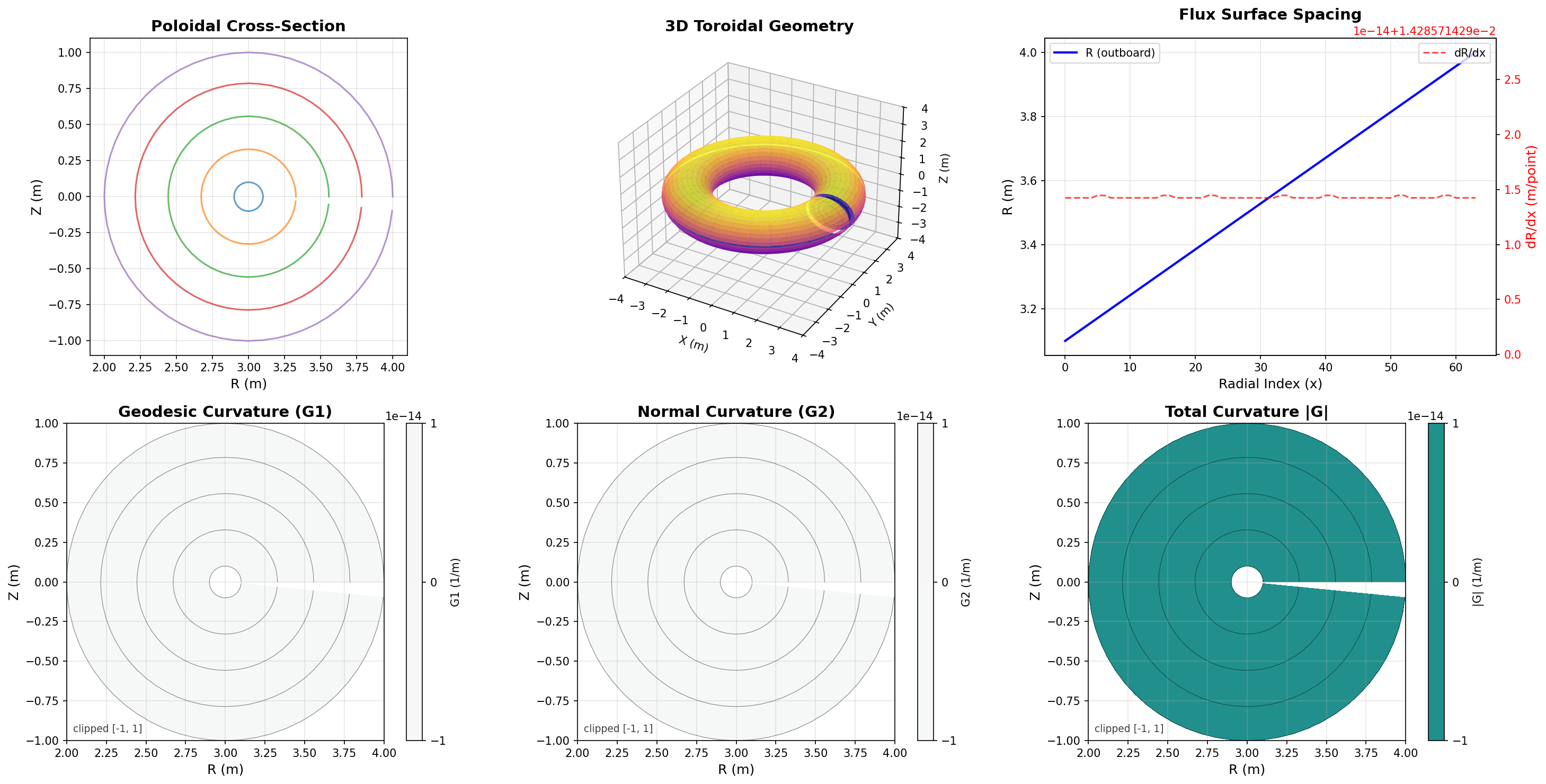
These tools enable rapid iteration on reactor geometries while ensuring simulations start from physically consistent, validated coordinate systems. Public release supports peer review and allows independent verification of our simulation framework.
GitHub: https://github.com/Chatwood-Labs
1D Reduced Models
Before running large-scale 3D simulations, we test concepts in 1D periodic ring models. These capture essential physics (fusion heating, radiation, transport, wake-aligned injection) while running in seconds instead of hours.
Key results from 1D studies:
- Reduced models show strong sensitivity to phase alignment, motivating full 3D validation.
- Phase-locking behaviour appears in parameter sweeps (lock-tongue structure), providing a control target.
- Energy accounting and numerical stability are actively tested across resolutions and timesteps.
- Convergence checks are run across multiple grid sizes to separate physics from discretization artefacts.
We treat early results as hypotheses until they reproduce under tighter models, independent checks, and sensitivity tests.
Real-Time Simulation Telemetry
Conventional fusion development waits days for simulation results, then spends additional time post-processing. We've inverted this workflow.
Our BOUT++ simulations stream live telemetry to instrumented dashboards, enabling real-time monitoring of burn wave propagation, plasma state evolution, and control response during active runs. This compresses iteration cycles from days to hours and allows rapid exploration of the phase-synchronized injection parameter space.
Current capabilities:
- Live 3D visualization of temperature, density, and magnetic field evolution
- Per-injector state monitoring and saturation detection
- Burn crest tracking and wake structure identification
- Energy balance and Q-factor evolution
- Automated diagnostic validation against control targets
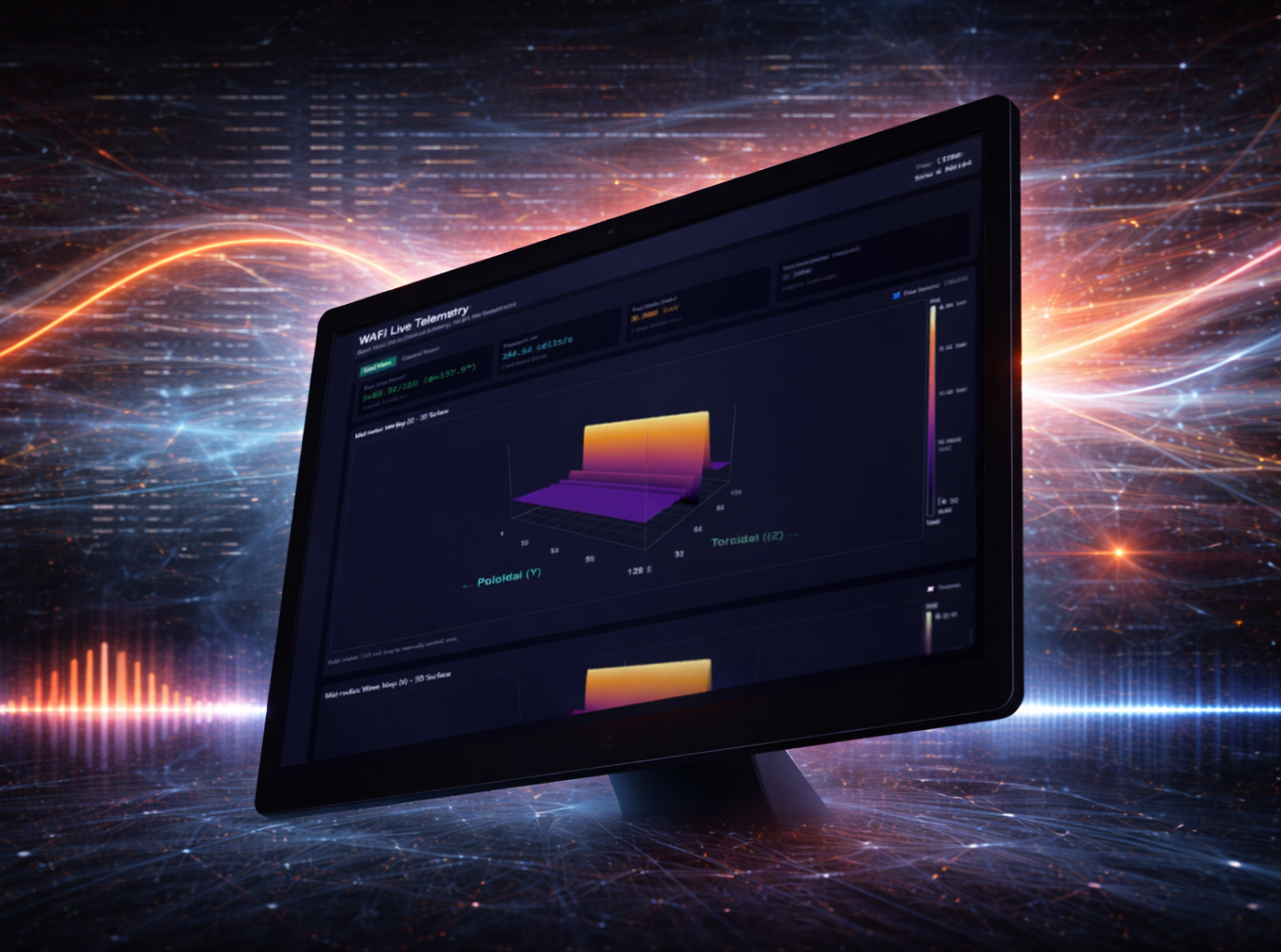
In development:
- Synthetic diagnostic systems mimicking real tokamak sensor suites (Thomson scattering, soft X-ray, bolometry)
- Control room interface for operator training on simulated plasma
- Hardware-in-the-loop testing infrastructure
This approach enables us to validate control strategies, train operators, and identify failure modes entirely in simulation before committing to hardware, reducing risk and accelerating the path to experimental validation.
Current Simulation Infrastructure
| Code Base | BOUT++ v5.x with custom physics modules. |
| Grid Resolution | ~68×128×128 (radial × poloidal × toroidal). |
| Timestep | 1×10⁻⁷ seconds (adaptive, stability-limited). |
| Telemetry | Streamed, in-run diagnostics enabling real-time inspection of plasma state, burn-front dynamics, and control behaviour during active simulation. |
Next Milestones
- Extended BOUT++ runs testing sustained propagation without external drive (multi-orbit regimes).
- Parameter sweeps: injection timing, crest velocity, pulse amplitude, alpha redistribution strength.
- Integration with ML-based crest tracking for adaptive control.
- Comparison with reduced models to validate transport assumptions.
- Technical documentation and external dissemination of validated results.