Compare actuator concepts
Evaluate gas, Laval and hydrogenic pellet configurations with configurable actuator placement and declared source conditions.
Fusion fuelling simulation and analysis software for comparing actuator concepts, deposition behaviour and traceable run evidence before moving into heavyweight plasma-response modelling or hardware development.
FUELLING SIMULATION & ANALYSIS
Stoker is a reduced-physics actuator, source and deposition study platform for fusion fuelling workflows. It is designed to compare fuelling approaches under declared assumptions and turn completed runs into traceable evidence that can be inspected, reproduced and carried into later engineering work.
Current workflows cover prescribed gas sources, quasi-1D Laval nozzle sources and hydrogenic D, T and DT pellets, with pellet ablation and optional reduced plasmoid-drift modelling available where the declared model conditions apply.

Stoker keeps actuator definition, reduced physics, run artefacts and validation in the same workflow rather than treating reporting as an afterthought.
Evaluate gas, Laval and hydrogenic pellet configurations with configurable actuator placement and declared source conditions.
Follow ablation, trajectories, penetration, deposition, confinement and boundary-loss behaviour using backend-specific run artefacts.
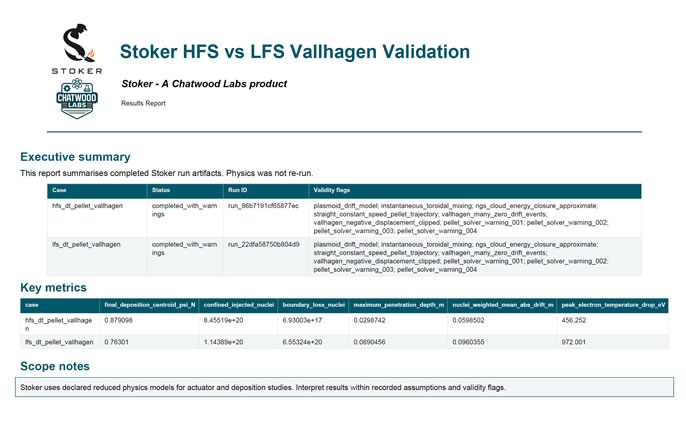
Validation checks, conservation records, warnings, hashes and provenance make the assumptions and output integrity visible.
Run packaged studies, rank completed cases, export source-term products and execute published benchmark checks from the same toolchain.
Stoker produces human-readable and machine-readable outputs so a result can be reviewed without reconstructing the entire calculation from memory. Across validation, reporting, study and export workflows, Stoker can generate PDF, HTML, Markdown, JSON, CSV, JSONL and NetCDF artefacts, alongside logs, plots and support bundles.
Public validation is built around named reduced models, deterministic fixtures, conservation checks and explicit warning states. A warning remains part of the evidence rather than disappearing behind a pass/fail badge.
DECLARED PHYSICS
The current Stoker physics stack combines deliberately reduced models for design-space exploration. Supported paths include quasi-1D Laval flow, a hydrogenic gas reaction network, Parks-Turnbull neutral-gas-shielding pellet ablation and conditional Vallhagen plasmoid drift, including Spitzer-Härm resistivity within the drift model.
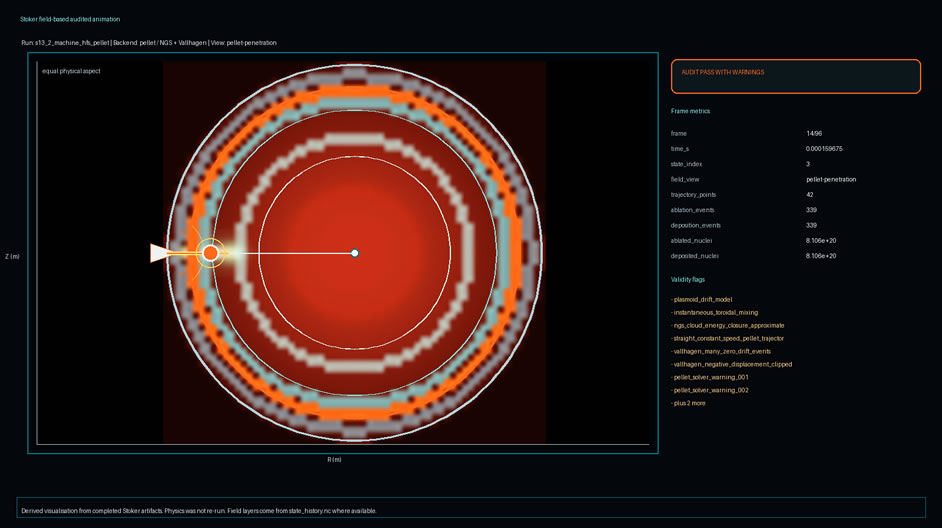
Current visual tooling can render dense simulation-state fields where they are available, preserve physical R-Z aspect ratio and overlay pellet penetration or species information for inspection and reporting.
The visual layer is derived from completed run artefacts, with its source data, validity context and visual derivation recorded alongside the output, so presentation does not become a separate undocumented interpretation of the calculation.
WHERE STOKER FITS
Stoker is not a full plasma-evolution code and is not presented as a replacement for tools such as BOUT++, JOREK, M3D-C1, SOLPS, EIRENE or integrated-machine modelling.
Its job is earlier and narrower: compare fuelling concepts, understand source and deposition behaviour, expose model assumptions and generate traceable artefacts that can inform the next level of simulation or engineering.
COMING SOON
Public release is planned soon. Technical evaluation, pilot engagements and commercial licensing discussions can begin before release where there is a defined fuelling or simulation requirement.